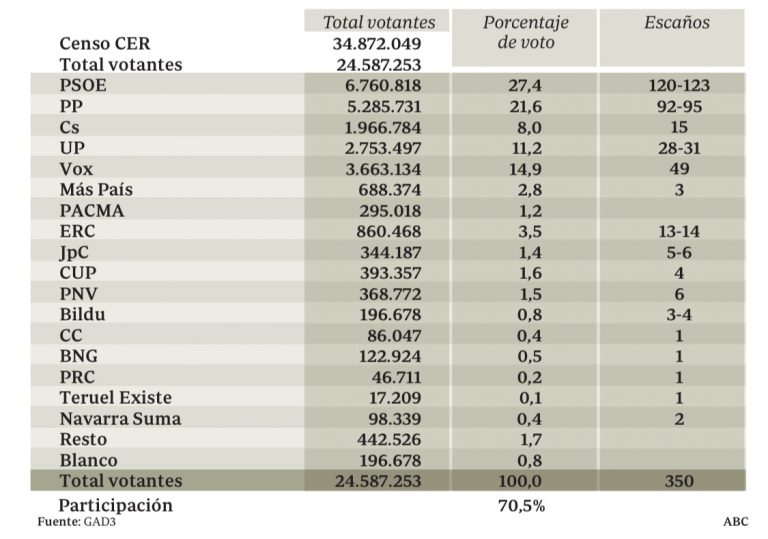
This is the results breakdown of the Congress of Deputies election held in Spain on 10 November 2019. The following tables show detailed results in each of the country's 17 autonomous communities and in the autonomous cities of Ceuta and Melilla, as well as a summary of constituency and regional results.
Electoral system
348 members of the Congress of Deputies were elected using the D'Hondt method and a closed list proportional representation, with an electoral threshold of three percent of valid votes—which included blank ballots—being applied in each constituency. Seats were allocated to constituencies, corresponding to the provinces of Spain, with each being allocated an initial minimum of two seats and the remaining 248 being distributed in proportion to their populations. Ceuta and Melilla were allocated the two remaining seats, which were elected using plurality voting. The use of the electoral method resulted in an effective threshold based on the district magnitude and the distribution of votes among candidacies.
As a result of the aforementioned allocation, each Congress multi-member constituency was entitled the following seats:
Voting was on the basis of universal suffrage, which comprised all nationals over eighteen and in full enjoyment of their political rights. Additionally, Spaniards abroad were required to apply for voting before being permitted to vote, a system known as "begged" or expat vote (Spanish: Voto rogado).
The electoral law allowed for parties and federations registered in the interior ministry, coalitions and groupings of electors to present lists of candidates. Parties and federations intending to form a coalition ahead of an election were required to inform the relevant Electoral Commission within ten days of the election call, whereas groupings of electors needed to secure the signature of at least one percent of the electorate in the constituencies for which they sought election, disallowing electors from signing for more than one list of candidates. Concurrently, parties, federations or coalitions that had not obtained a mandate in either chamber of the Cortes at the preceding election were required to secure the signature of at least 0.1 percent of electors in the aforementioned constituencies. The electoral law provided for a special, simplified process for election re-runs, including a shortening of deadlines, the lifting of signature requirements if these had been already met for the immediately previous election and the possibility of maintaining lists and coalitions without needing to go through pre-election procedures again.
Nationwide
Summary
Constituencies
Regions
Autonomous communities
Andalusia
Aragon
Asturias
Balearic Islands
Basque Country
Canary Islands
Cantabria
Castile and León
Castilla–La Mancha
Catalonia
Extremadura
Galicia
La Rioja
Madrid
Murcia
Navarre
Valencian Community
Autonomous cities
Ceuta
Melilla
References
Bibliography